
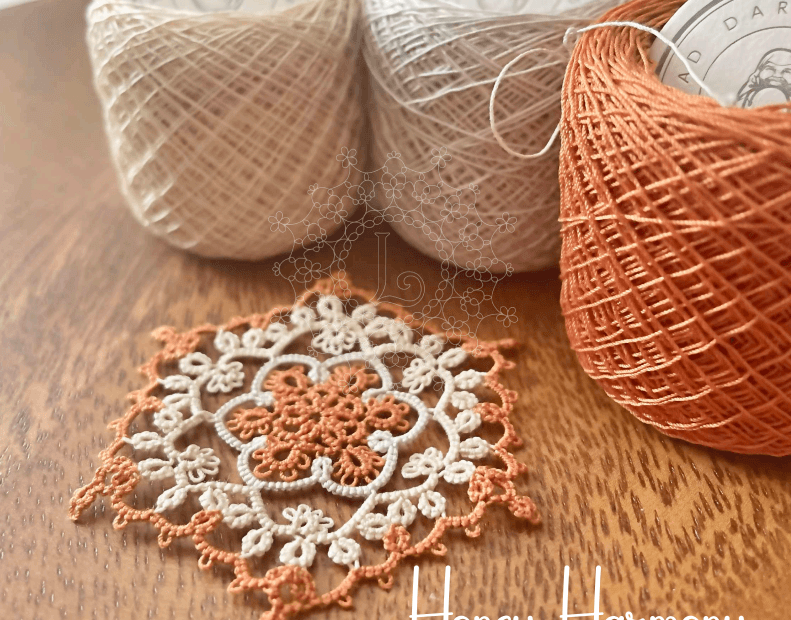
There’s something wonderfully fitting about a hexagon-shaped tatting motif being named after honeycomb. The geometry alone tells the story before you even pick up your shuttle — six-sided symmetry, layered petals radiating outward, and a delicate structure that echoes the natural architecture bees have perfected over millions of years. This free pattern, called Honey Harmony, captures that inspiration beautifully, and it comes with a story behind the name that’s worth sharing.
The Inspiration Behind the Name
The designer behind this hexagonal motif noticed the resemblance to honeycomb almost immediately, and the name Honey Harmony followed naturally. But there’s a more personal layer to the story as well. She admits to having a long-standing, slightly irrational fear of bees — the classic worry of getting stung keeping her at a respectful distance whenever one buzzes by. At the same time, she carries a quiet sadness about the ongoing decline of bee populations around the world. Bees play an essential role in pollination and the broader health of ecosystems, and their diminishing presence in gardens everywhere is something she notices and misses, even as someone who keeps her distance from them in person. It’s a lovely bit of contradiction — fearing something while still recognizing its importance and mourning its absence — and it adds a layer of meaning to a motif that might otherwise just be a pretty shape.
What You’ll Find Included in the Pattern
This free pattern comes with two formats, so it should suit tatters regardless of how they prefer to work. A visual diagram/chart is included for those who like to follow along stitch by stitch through a graphic representation, while a fully written-out pattern is also provided for those who prefer traditional text instructions. Having both options available makes this pattern accessible to a wider range of skill levels and personal preferences, which is always a thoughtful touch in a free release.
Tatting Technique, Not Crochet
At first glance, this motif might be mistaken for a crochet piece, and it’s easy to see why — the layered floral design and lacy border have a look that overlaps with crochet motifs. But this is tatting through and through, built from small, tightly formed rings rather than crochet stitches. That distinction matters: the ring-based construction of tatting gives finished pieces their characteristically delicate, almost jewel-like quality. Where crochet often has a slightly looser, more textured drape, tatted lace tends to hold its shape with crisp, defined edges, thanks to the way each ring is closed and secured.
A Gap in the Pattern Worth Noting
One thing to keep in mind before diving in: the pattern doesn’t specify a particular thread size, nor does it indicate the finished dimensions of the motif once complete. This means a bit of experimentation is in order. Tatting thread size can dramatically affect both the finished measurements and the overall look of a piece — a size 20 thread will produce a noticeably different result than a size 80, both in terms of finished size and the fineness of the lace. If you’re aiming for a specific end use (say, a headband versus a larger decorative piece), it may be worth tatting a test motif first to see how the size and thread combination翻译 out before committing to a larger project.
Experimenting with Calais Metallic Threads
The designer also mentions she’s been testing this pattern using Calais metallic threads, and the results apparently surprised her in a good way. Metallic threads can behave quite differently from standard cotton or synthetic tatting threads — they often have a slightly different hand-feel, a bit more resistance when pulling stitches tight, and of course, that eye-catching shimmer once the piece is complete. For a motif inspired by honeycomb, a metallic gold or amber-toned thread could add an extra dimension, catching light in a way that reinforces the honey theme even further.
Imagining the Possibilities
Part of what makes a single motif pattern like this so appealing is the open-ended nature of what you can do with it once you’ve mastered the basic shape. The designer herself mentions envisioning several motifs connected together to form a headband, or scaled up into a larger lace piece entirely. Both are excellent directions, but the possibilities don’t stop there. A row of these hexagons joined edge to edge could become a striking trim for a shawl or blanket edge. Individually, a single motif makes a lovely coaster, ornament, or even the centerpiece of a pendant if backed with fabric or stiffened slightly. Joined into a larger grid, the honeycomb shape lends itself naturally to a table runner or doily with a cohesive, thematic pattern running throughout.
A Note on Tatting as a Craft
For those newer to tatting, it’s worth noting just how portable and meditative this craft can be. Unlike some fiber arts that require significant equipment or workspace, tatting typically only needs a small shuttle or tatting needle and a length of thread, making it easy to pick up and set down as time allows. The repetitive nature of forming rings and chains also makes it a wonderfully calming, almost rhythmic activity once the basic techniques are second nature.
Tatting also has a long and storied history, often associated with delicate lace edgings on linens and clothing in past centuries. Modern tatters have taken that traditional technique and expanded it into contemporary applications — jewelry, home décor, and even wearable accessories like the headband idea mentioned above. Patterns like Honey Harmony are a great example of how a classic technique continues to evolve, blending traditional stitch structures with fresh, modern inspiration drawn from the natural world.
Here is the link to this free tatting pattern!
Image and Pattern Source: Lillian Tatlace